

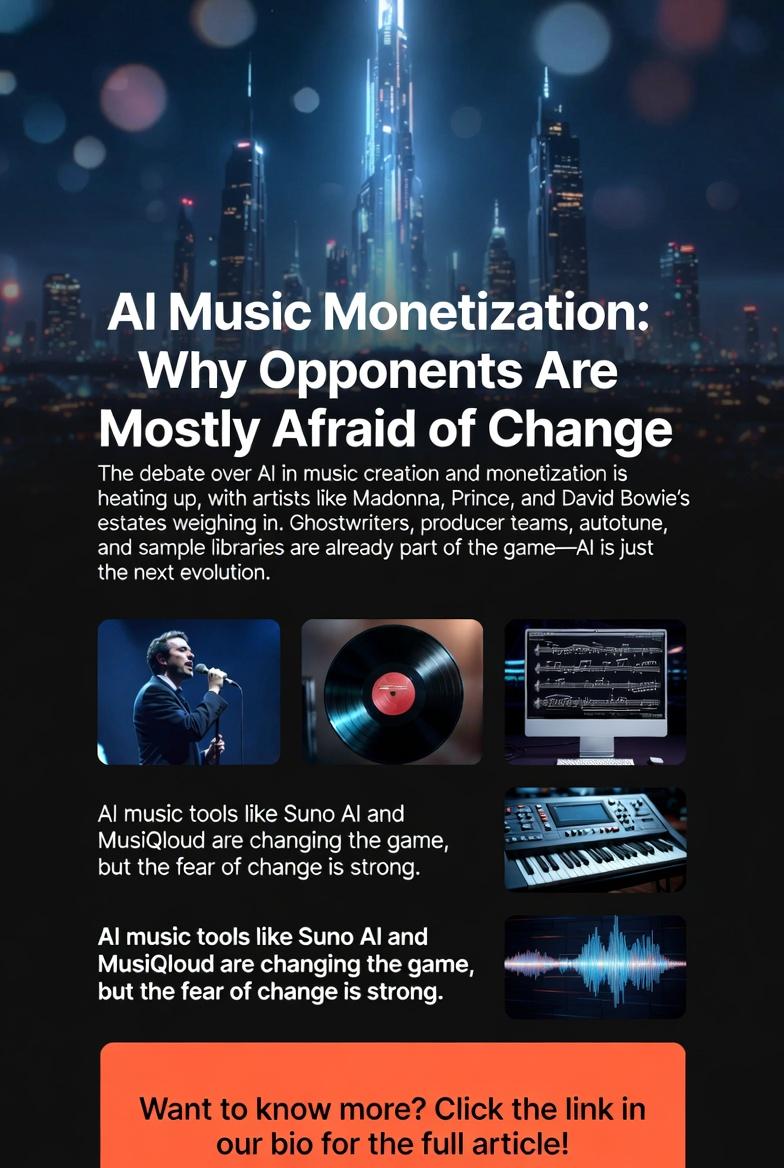
AI Music Monetization: How to Monetize While Preserving Meaning
Let’s get real: there’s always someone claiming music must stay “pure.” That it should only come from passion, love for the art, or some mystical inner calling. But the moment money enters the equation, suddenly it’s “tainted.” Here’s the truth: that’s an illusion.
1. Art Has Always Had Money in the Mix
Artists have been creating music, poetry, and visual art for centuries that combine expression with income. Think of Madonna, Prince, or David Bowie. Do you really think they didn’t care about earning from their work? Of course they did. Art and income are not mutually exclusive.
Claiming AI music is somehow different because it involves a machine is misguided. It’s just a new tool. Pens, pianos, synthesizers, and software—AI is simply the next evolution. The tools change, the art remains human.
2. Hypocrisy in the Music Industry
It’s fascinating how critics of AI monetization often accept:
- Ghostwriters
- Producer teams of 10 people
- Autotune and sample libraries
Yet let someone use AI to create a similar track, and suddenly it’s a moral crisis. AI is not the enemy—fear of change is.
3. Fear of Losing Control
The real objection isn’t about purity. It’s control. AI lowers the barrier to entry. Suddenly, anyone without a studio, label, or budget can produce music that sounds “good enough.” That’s threatening for those used to exclusivity.
4. Flipping the Question
The Facebook question: “Would you still make AI music if you could never make money from it?” Flip it: how many traditional musicians would continue if they could never earn a dime? Many would quit. Recognition, reward, and yes, a little financial comfort, are human needs.
5. Monetization Is Not Evil
AI music should be monetized, provided creators:
- Are transparent about AI usage
- Do not copy or exploit other artists
- Infuse their own creativity and vision
AI alone doesn’t make music magical. Human taste, vision, and direction are always what separates a resonant track from generic noise.
6. Case Study: Innovative Creators
Many people dabble in AI music for fun and quit. Innovative creators are building anthems, writing guides, and launching platforms that showcase AI music. That’s vision, creativity, and entrepreneurship—not just pressing a button.
7. The Bottom Line
Anyone claiming AI music shouldn’t be monetized is really saying: “I’m afraid of losing my position, so I’ll prevent others from succeeding.” That’s fear, not principle. AI in music is here to stay. Monetization isn’t the enemy—lack of skill and fear of innovation are. Smart creators combine human talent with AI to create music that resonates emotionally, impacts audiences, and yes, can generate income.
8. Monetization ≠ Meaningless Music
Monetization alone doesn’t destroy art—but how you structure it matters. Pure monetization, especially with AI, can incentivize volume over quality. Since the barrier is so low, generating thousands of tracks with minimal effort becomes economically rational—but that doesn’t have to define AI music.
The key is curation and intentional design:
- Reward value, not volume: Platforms could prioritize community appreciation over raw streams.
- Verified creator identity & provenance: Knowing who shaped the music adds meaning.
- Transparency as a feature, not a bug: “Made with AI” can be a mark of creativity, not shame.
9. Redefining the “Maker”
It’s no longer about who literally presses the keys—or types the prompt—but who frames the intent, curates the output, and shapes the context. AI is the brush; human creators still provide vision. Similar to how photographers work with AI-generated images: the photo isn’t “just AI”—it’s the human eye, the selection, and the context that define it.
10. Building a Sustainable Ecosystem
AI music can flourish alongside human art—but only if platforms and creators invest in quality and curation, not just algorithmic distribution. Key pillars for a sustainable ecosystem include:
- Hybrid creation as the norm: AI as a starting point, not the endpoint.
- Transparent storytelling: Sharing the “why” behind a prompt or track gives listeners context and attachment.
- Meaning over metrics: Value should be measured by engagement, significance, and artistic vision, not just streams or revenue.
Innovation in AI music—new genres, accessibility for people with limitations, unexpected collaborations—is real. But without intentional structure, there’s a risk of low-effort noise overwhelming the ecosystem, ultimately devaluing both human and AI-assisted creations.
Join the group AI Music Creators on MusiQloud and share your tracks with a growing community! 🚀
Bottom line: AI music monetization works best when meaning drives the system, not just dollars. Platforms that encourage curation, transparency, and intentional creativity will shape the future of music for the better.

 English
 Arabic
 French
 Spanish
 Deutsch
 Turkish
 Dutch
Dutch
 Italiano
 Russian
 Romaian
 Portuguese (Brazil)
 Greek
Greek